A Close-in Perspective
by
Jeff Howard
Mar 4, 2026
15 min read
The main purpose of design competitions in the fields of sculpture, architecture, and landscape/site design is to obtain the best concept. Once a winner is chosen, however, the design work typically transitions into the hands of certified and experienced professionals who transform “a big idea” concept into a buildable set of documents to steer its construction. In the case of Maya Lin’s winning entry, this transition meant the selection of an “architect-of-record” to implement all of the architectural design, engineering, site design, and drawings and specifications needed to produce a “bid set.” This design package, once approved by the local and federal review boards, went to construction management contractors deemed the most qualified to bid on realizing a now-highly-detailed, highly specialized design.
The Cooper-Lecky Partnership, a Washington, DC-based architecture firm, was chosen jointly by Maya Lin and the project sponsoring Vietnam Veterans Memorial Fund as the architect-of-record, and consistent with the rules of the competition, Lin was retained by the firm to consult on the design process. As I had several years with the firm as a designer, model maker, and model photographer, Kent Cooper, the firm’s partner-in-charge of design, chose me to serve as Lin’s “design attaché.” This meant that I was assigned to work directly with Lin from the beginning on every aspect of further developing her concept.
This process began with what might best be deemed a “Discovery Phase” to make sure a number of her key design parameters would - and could - be met. We then proceeded into Schematic Design, delivering a scale model of the Memorial placed in the overall site context, model photo renderings, scale plans, and elevations, along with specifications for materials and methods of construction. Given the unique demands and constraints of the project, my work quickly expanded into building full-size mock-ups for Lin to experience in-person on the actual site. This enabled her to visualize the actual height of the wall, the locations of dates marking the start and end of the war, the sizes of the granite panels, and the look and feel of what would become tens of thousands of engraved names.
The Key Drivers of Maya Lin’s Design
So, let’s look back to Lin’s concept sketches and her powerfully written description of the symbolism and emotional connections she intended to deliver in the built memorial. These were now the key drivers we needed to fully understand in order to evolve her brilliant design into a buildable set of drawings.
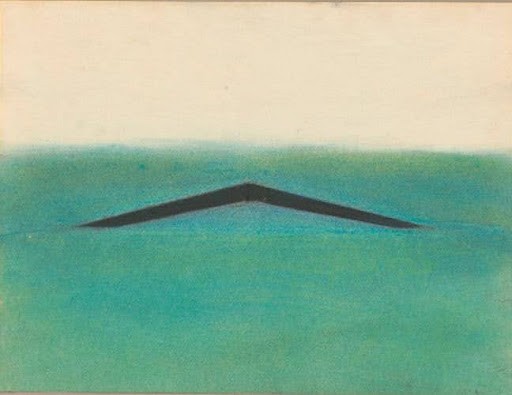
The first of two of Lin’s pastel sketches on her competition presentation boards: pure minimalism.
A “Rift in the Earth”
One of Lin’s pastel sketches depicted a black wall with two legs angled apart, the legs extending outward from a tall inside vertex and tapering down to meet the earth at their ends. These walls were to be “inset” as an amphitheater into the grassy expanse of the designated site on the National Mall. The surrounding lawn was meant to extend to both the tops, from behind, and the bases, in front, of the legs along their entire lengths — which Lin estimated at 200 feet each. Put simply, this memorial — as one of the competition judges, Costantino Nivola, put it — “would rise no taller than a pigeon.” Put another way, visitors would descend toward the vertex with the walls becoming ever taller and surrounding them as they approached. Inside the vertex the legs, measuring about 10 feet tall, would rise four to five feet above their eyes. Per Lin’s written description, the wall would purposefully NOT overwhelm anyone with its scale. Instead, it would provide a sheltered space for contemplation of the service and sacrifice of loved ones, dear friends, and comrades-in-arms. As it happened, the very idea that these walls should be black — and not conventional white marble — quickly ignited one of the most contentious issues impacting the winning design, right alongside its being inset “shamefully below grade.”
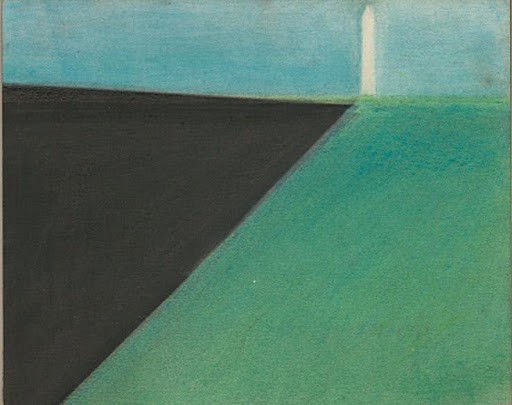
Maya Lin’s second pastel sketch showed how one wall points toward the Washington Monument.
Orientation toward Historic Landmarks
It was crucial to Lin’s concept that one leg of the wall pointed toward the Lincoln Memorial and the other toward the Washington Monument. Her clear intent was to enhance the power and meaning of this “new” memorial by anchoring it to perhaps what were the nation’s two most historic “monuments,” surely the two most prominent at this west end of the Mall. When she visited the site for her architecture class — the class where all were assigned to enter the design competition — she clearly took note of the prominence of these two iconic memorials within this site’s viewshed.
No Paving and No Lighting
It was clearly implied in Lin’s sketches that grass lawn would extend up the faces of the walls to resemble an outdoor amphitheater. In short, there would be no paving, neither paths nor a paved assembly space. She assumed that visitors would approach from all directions, descending what was now a “grassy bowl”, with a shallow grade to promote accessibility. As the design process progressed, and handicapped accessibility requirements were considered, a gray granite walkway was added running the entire length of the walls and a few feet away from their faces to provide access.
With regard to site lighting, the general assumption — held by many — was that the public would come only by day. What happened, however, the Memorial the moment it opened, was that the Memorial drew throngs of visitors, and many of them preferred to experience it at night. Lighting of the wall would be added after several years, along with bands of granite cobblestones on either side of the granite walkway to accommodate the far larger crowds and the tributes of every conceivable size and shape that visitors would place all along the bases of the walls. A group of Wisconsin veterans even left a custom-built Harley-Davison motorcycle in tribute!
A Wall of Reflection
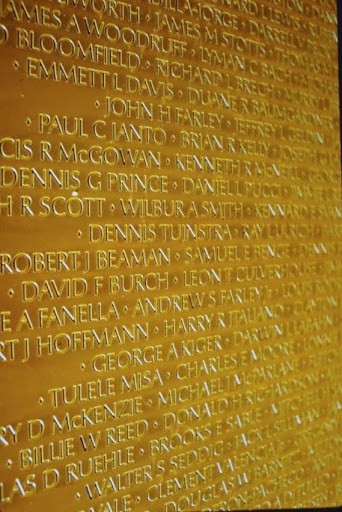
Without question, Lin’s plan that the wall be faced with polished black granite delivered power that few of us imagined. The “near infinity” of names engraved on the walls gained all the more power and presence because the black granite’s polished finish literally reflected all visitors, so many of them veterans and family members gazing at the name of a lost loved one. It is this mirroring effect — where the “endless” names of the fallen appear to float between you and your reflected image — that has made this memorial such a deeply resonant experience for millions.
Names to Emanate Chronologically from the Vertex
According to Lin’s concept, the list of the names of the fallen and missing would both start and end at the vertex of the walls in the chronological order of the dates of casualty. The year of the first deaths and the prologue of an honoring inscription would be carved at the top of the east wall. The list of the names would proceed to the right from there, progressing week by week and month by month. The list would extend to the end as the wall tapered into the lawn. The list would then resume on the west wall “emerging from the earth,” to again progress to the bottom of the west wall at the vertex. There the date of the final casualties and the epilogue of the inscription would be carved.
Lin’s idea was that it would be the visitor who would serve as the “bridge” that completed this “circle,” connecting the procession of names from beginning to end. Her core idea of the names unfolding before you, in the order in which they were lost, garnered as much heated criticism as her use of black granite. One outspoken critic insisted that engraving the names chronologically would reduce these honored heroes into a “random list of traffic accidents.” It cannot be overstated how wrong this criticism proved to be. Countless visitors have found themselves overcome with emotion as they finally find their loved one or battlefield buddy on the wall, only to recognize nearby one or more names of those shot down in the same chopper or killed in the same skirmish. Comrades forever together, their engraved names floating against the reflection of the sky and landscape, and hovering in front of the faces of those who have come to offer tribute and remembrance.
No Statues, No Flags, No Ornaments
Lin’s original design was rooted in its stark simplicity, with the black polished granite wall “emerging” out of this essentially flat grassy site having no other symbolic components beyond the countless names, the dates, and the brief inscriptions engraved. There would be no flag, there would be no figurative sculpture of soldiers (her wall with thousands of names was the sculpture), and there would be no added ornaments incorporating military or other emblems or medallions. This minimalist design not only would come to represent an amazing paradigm shift in what memorials world-wide would come to represent, but would attract very vocal demands to add these “necessary features.”
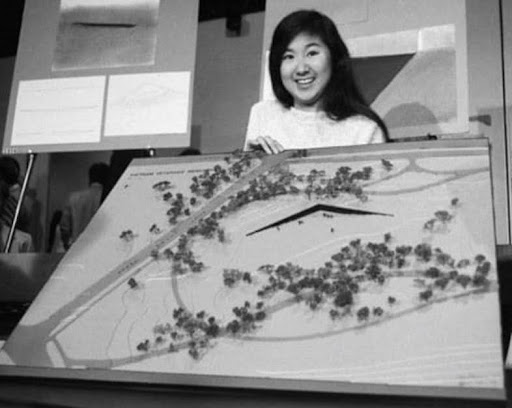
Maya Lin at the press conference on May 6, 1981, to announce her winning design. She holds a scale model produced for the event.
The Discovery Phase
After the events celebrating the winning concept, the work commenced to translate Lin’s concept sketches and written description into actual materials and forms real-life scale. Definitely helping the initial research effort was the countless memorials and monuments of every era in Washington, rendered in a wide range of materials, including several that deploy polished black granite. Maya and I explored the Mall and Arlington Cemetery in search of examples that could inform us of key essentials. How exactly does polished black granite mirror the visitor and the surrounding landscape? How impactful is it to see yourself being reflected in this rather muted, yet truly ethereal way? It turned out that the Seabees Memorial on the formal drive into Arlington Cemetery was not only built of polished black granite, but the inscribed words were hand-chiseled and infill painted in a way to read as far brighter than the black background. While on so many other memorials fashioned of dark stone, the words read darker and counted far less. As fate had it, we later found that the stone carver we eventually chose, John Benson, had chiseled the words on the Seabee Memorial. His aesthetic input on the font and the Memorial the size the names and the space between lines of names proved essential to the final look and feel of the memorial the Memorial.
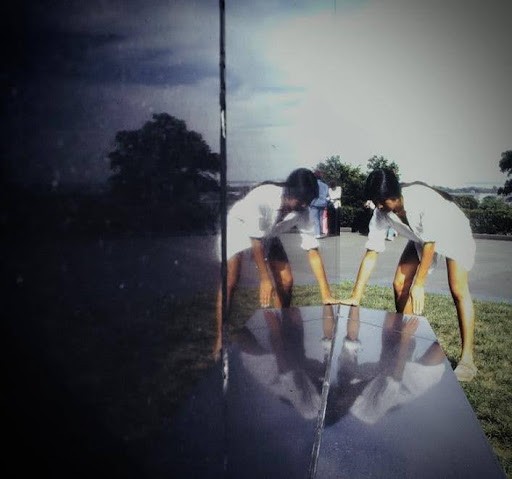
Maya Lin at the Seabees Memorial experiencing her own reflection and the look and feel of the reflected landscape.
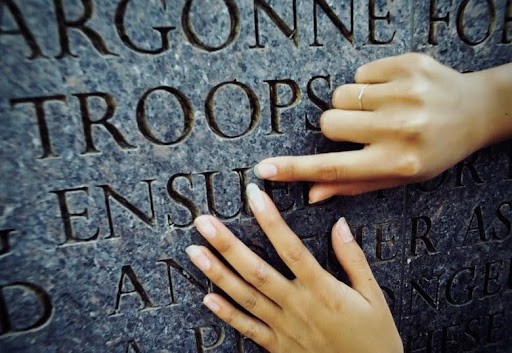
Maya Lin exploring the tactility of sandblasted names at the General Pershing Memorial (now the World War 1 Memorial). Note how dark the letters read against the stone. Note, too, these words are well over twice the size that the names would be engraved into the Memorial the Memorial.
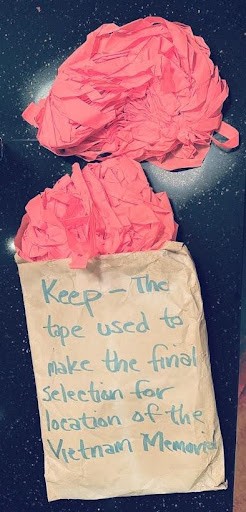
The surveyors’ tape Maya Lin bought to help determine the actual location of the Memorial
The Search for the Sweet Spot
In order to locate the vertex of the walls, several other young architects from Cooper-Lecky joined Maya and me at the site. She had bought dayglo surveyors’ tape to nail down where the two walls would meet. She also brought a pair of binoculars and walkie-talkies. She then announced that she would climb to the top of the Washington Monument and instruct us, by way of the walkie talkie, how to lay out the walls “in real time”. In short, she would perch herself at the top of the very monument to which she wanted the north wall to point, and from there direct us to fine tune the corner, and the angle of each of the walls.
As she walked off to climb the Monument, we unraveled the two lengths of pink/orange tape and started looking for a likely spot to place the vertex in preparation for any tweaking Maya would relay via her walkie talkie. Needless to say, there was active discourse and debate among us about where the vertex should be, which continued while receiving no word from Maya to “start adjusting the ribbons.” In fact, she was not answering our repeated calls to her.
After perhaps 20 more minutes, Maya reappeared and informed us that she couldn’t get through via the walkie talkie. So, reunited, we had her comment on various vertex locations we had considered. We came to agreement on the “sweet spot” and rolled out the ribbon east toward the Washington Monument and southwest toward the closest corner of the Lincoln Memorial. We had brought a wooden stake with us, so we pounded it low into the grass and flagged it with a short strand of the pink tape so we could retrieve it when the civil engineer’s crew came to the site to finalize the layout of the walls. As the vertex was now known, the exact angle of the walls could readily be derived from detailed maps and aerial photos.
Reinforcing the Grassy Bowl
The idea of having visitors approach the wall across a gently-graded “amphitheater” of grass lawn led us to explore options to strengthen the turf. We couldn’t envision square grids of slatted steel being shaped to conform suavely to the curves of the “bowl” in front of the walls (see photo). So, the search shifted to products and methods that protected the roots, which led us to think of the punishment inflicted on the grass on football fields. Further exploration led to a research project at Purdue University that had just resulted in a commercially available product called “Prescription Athletic Turf.” The concept was to deploy under the grass a nominally 2” thick webbing of heavy-duty plastic designed to absorb and distribute the weight of everyone’s feet. This product was indeed specified and installed beneath the sod surrounding the Memorial.
The thousands of people, many of them veterans and family members, who came to pay tribute at the Memorial’s dedication on Saturday, November 13, 1982, after a heavy rain the night before, tested the recently installed “reinforced turf” above and beyond its limit. Many areas devolved into mud with the plastic webbing exposed. This necessitated upping the capacity of the French drains and replacing large areas of the sod, roping it off for a longer period to enable the sod to truly “take root”. Today there is a low-slung chain on stanchions to keep visitors on the now-widened path along the wall faces, so the “grassy bowl” is spared “over use.”
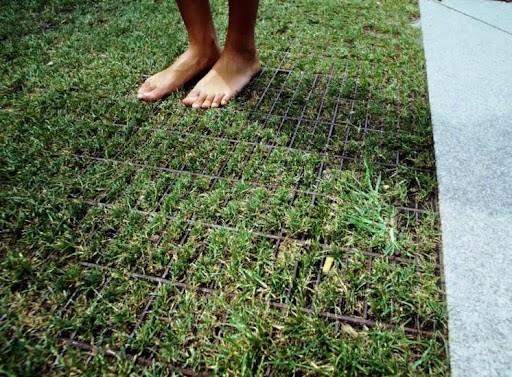
In the very early 1980’s there were few options for reinforcing grass against heavy foot traffic. Here is May Lin standing on a grid of steel slats embedded in the turf, which she rejected for its unnatural look and harsh feel.
Schematic Design
The Discovery Phase seamlessly morphed into Schematic Design, with the clear aims of resolving the overall size and shape of the walls and calculating how to array the names across them. Since the vertex of the walls had now been located on the site, the work moved quickly to determine the height and length of the walls. It became clear that the walls needed to be comprised of panels of consistent width. So, the choice of granite would determine that width, depending on the width of the rock vein in the earth. Lin compared a number of black granite samples, assessing the darkness of the color, the uniformity of the surface patterning, and the mirroring effect created by the high-polished finish. There was some comment about the source of the final choice, there was no doubt that the stone from a quarry near Bangalore, India, met all of Lin’s criteria. Nothing equivalent was available domestically; the black granite on the Marine Corps Memorial had come from Sweden.
With the source of the granite determined, the dimensions of the panels became a key driver of the wall lengths. According to the Bangalore quarry, a panel — if it were to read truly “pure black” with no veins or aberrant “crystals” — could not exceed 40” in width. Lin’s written description had specified 10 feet for the desired height on the inside of the vertex, so two very clear criteria now guided a host of other explorations, the first and foremost being the size of the font for the engraved names. Little did we know how complex a riddle the size and spacing of the lines of names would be to solve, as they literally drove the length of the two walls as the 40” wide panels would have to accommodate over 58,000 names.
The Look and Feel of the engraved Names
I started experimenting with font styles and sizes, as well as the spacing between the lines of names, a spacing known as “leading.” Nothing was working in terms of the names’ presence or how striated typical leading made the overall panel look. Fortunately, at this point John Benson, the project’s stone carver arrived on the scene to offer his expertise, partially based on the polished black granite and infill painted lettering of the Seabees Memorial. He proposed a direction nearly opposite from my explorations of fonts, suggesting that the font be very wide with “perfectly circular O’s” and the leading between lines be kept very tight — far tighter than typical typographic standards provided. Benson’s idea of creating a “netting of names,” in my opinion, makes the reflective quality of the polished granite even more impactful. Countless visitors have placed hands on the names of sons, brothers, husbands, and friends and leaned forward to see their own reflection staring back through the names. This “moment of connection” embodies the power of “being there” at the Memorial.
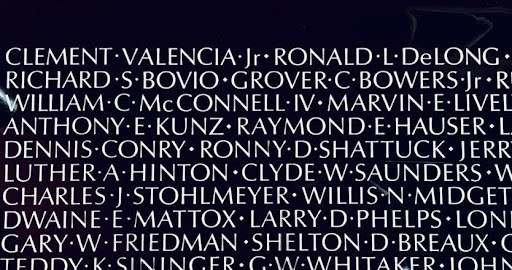
A blackline print made from the negative of my hand-rubbed-down names. It uses John Benson’s recommended Optima font with very tight spacing between lines. One indication that it is the first mock-up are the small diamonds between parts of each name, whereas the built panels have slightly larger diamonds only between whole names (or “plus” symbols if the person is still missing).
With the typography now determined, I purchased the then commonplace “Letraset rub-down letters” in the Optima font that Benson had advised us to use. I rubbed down ten tightly-spaced lines of actual names from the list for the Memorial, in all-caps Letraset letters approximately 5/8” high (48-point size), i.e., black letters on white mat board. Lin suggested that there be a diamond-like shape placed between each name to prevent names “running together.” When it became known that the Memorial list included approximately 1,300 Missing In Action (MIAs), she proposed that for these the “plus” symbol be used instead of the diamond shape. If the person was ever discovered to have died, then the diamond could be hand-carved over the plus.
The 40” wide panel size suggested that each line could contain five names, so my mock-up included 50 actual names. I had a number of full-size negatives made so these ten-line blocks could be taped together and repeated to mock-up the two panels on either side of the ten-foot high vertex. These assembled negatives were then run as blackline paper prints. After fabricating the four panels and adding in the starting and end dates in far larger font, we brought the four 10’ high panels to the Memorial site for Maya to evaluate. The mock-up obviously could not replicate the polished surfaces, but the scale was accurate, the “netting of names” approach was clearly shown, and the key idea of the names being engraved white into the black granite was locked into the design going forward. The only lettering that John Benson ended up hand carving were the start and end dates. All else was “sand-blasted,” using a newly invented stencil process created and brought to the project by Larry Century, a young inventor.
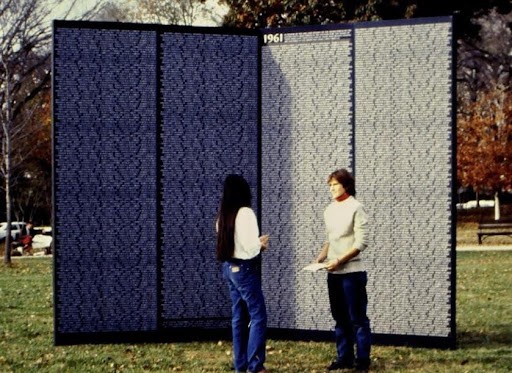
Maya Lin and an architecture intern in front of the life-size mock-up at the Memorial site. Two ten-foot high panels on either side of the inner vertex, including the start and end dates and the inscriptions next to the dates.
Codes Come to the Fore
The National Park Service brought to our attention a number of accessibility and safety conditions (“codes”) that had to be taken into account. First was the strict requirement of handicapped-accessibility, in the form of a paved path along the front of the walls and connected to existing paths at each end of the Memorial. To avoid including railings, the path could not exceed a very gentle slope of 1:20, meaning a foot of descent for every 20 running feet of path. A 10-foot high vertex, as proposed on Lin’s competition boards, meant that the path would need to be 200 feet long. The paved ramp before one wall could not just descend to meet the sloped ramp before the other, as there had to be an ample level area at the vertex. So, I considered all the subtle tricks the Greeks had played with the actual shape and details of columns to make them look straight, such as the subtle diversions from straight sides of the columns that result in the eye not detecting “bulges” in their middles. I also realized that the tops of the walls, if truly plumb level, actually would look like they dipped toward the center. Hence, we studied slanting the tops of the walls ever so slightly up toward the vertex, which had the added advantage that the path did not have to descend a full 10 feet. This made the 1:20 slope achievable with an ample level area at the vertex. A close look at the built wall reveals that the lines of names step up a line every fourth or fifth panel. The angle indeed is subtle, just like Greek proportional tricks, while the top of the wall actually appears to be level.
Another safety regulation would have forever altered the pure geometry of the walls. We had to consider that visitors, approaching the top of the wall from the back side and unaware that the wall was there, could walk right off and fall ten feet. Anything taller than a 12” drop in an open setting like this normally would require a 42” high guardrail, and there was simply no architectural way to insert this “feature.” So, we proposed a workaround that turned out, rather remarkably, to be deemed acceptable. That took the form of a 12” high curb of the same black granite, located about ten feet behind the top of the walls and running parallel to the walls. This curb would alert anyone approaching from the back side that something warranted their attention. Fortunately, this minimal solution was approved, as any guardrail would have totally altered the Memorial’s pure form.
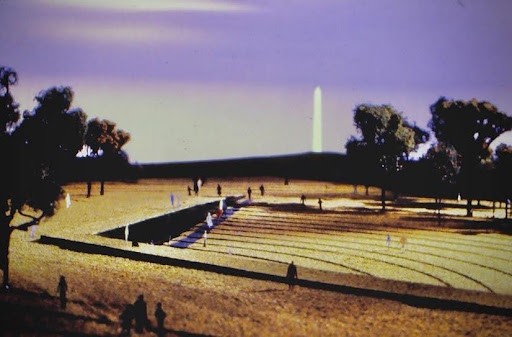
The updated scale model with the Washington Monument in the background. Note the accessible path required by the National Park Service and the granite curb along the entire length of the Memorial.
An Updated Scale Model
Much more time and energy would go into reconciling the final lengths of the walls so that they would contain exactly the entirety of the names, once the font size and leading was finally resolved. Once the series of calculations appeared close, we were finally able to build a scale model for model photography to simulate the overall site context for all stakeholders to experience. Again, it was the early 1980’s, and we are still building architectural models out of chipboard to represent the topography. To provide a better sense of the grassy site, we deployed “model railroad” materials to represent the lawn and visitors, while handcrafting trees and the mirror finish walls. I deployed a large roll down backdrop and projected images of the Washington Monument to simulate the key historic alignment called for in Lin’s design concept.
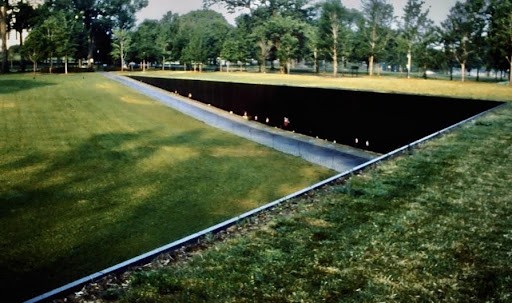
The Memorial as it was initially designed and installed, showing its fidelity to Maya Lin’s winning design concept. The “rift in the earth” surely echoes her pastel sketches, save for the added path.
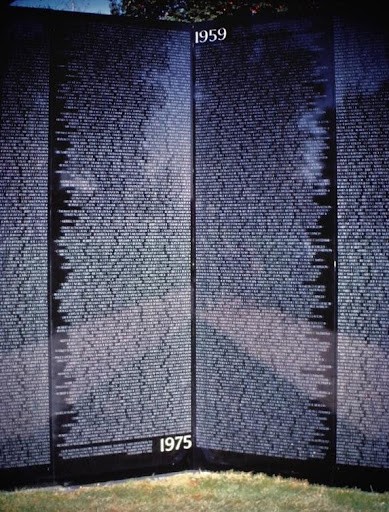
The inside vertex as-built with the carved dates, the inscriptions, and the names in chronological order starting and ending at the vertex. The reflections are very much present and powerful.
A photo of the first test panel of the emulsion that Larry Century proposed to be applied to the granite panel faces to enable names to be engraved crisply and cleanly through a photographic process.
Sandblasting the Names
The modest size of names and the sheer number of the fallen meant that the names could not be hand-carved into the stone. The issue therefore became how best to crisply engrave them into the granite in a way that would deliver contrasting letters against the black background. Out of the blue we were contacted by a young inventor, Larry Century, who said that he had invented a process that might help us inscribe the names. He had invented a photosensitive emulsion that could be spread on a surface. After it dried, it could still be washed off with water - as long as it hadn’t been exposed to light. But after exposure, it no longer was water soluble and formed a tough surface coating for a stencil for sandblasting. Hence, the names could be crisply engraved into the granite panel faces at enough depth to be tactile to the touch. With a glass company in Memphis, we put Century’s invention into production and sandblasted all the names in a three-month period.
Opening Day
As the photos above attest, the Wall “as-built” came as close as “codes would allow” to embodying the look and feel of Maya Lin’s concept sketches, while delivering her core aims of a highly contemplative and deeply healing experience for veterans, families, and friends of the fallen. All the thousands of names of those who made the ultimate sacrifice for our nation are now there to be seen dominating a wide panorama filling your view in a unified tribute…names glowing against a reflected world and the faces of those come to honor them.
And despite the general assumptions that the overall attendance on a daily basis would be modest in size, word quickly spread that you needed a direct experience of the Wall, leading to special trips by thousands, soon to be millions on a yearly basis, both by day and late into the night. And of course, the annual Memorial Day and Veterans Day commemorative events attended by tens of thousands, the latter for years revolving around the Rolling Thunder motorcycle rally, quickly drew participants nationwide.
And, yes, it is true that the design journey did not end on opening day. There would soon be the addition of a figurative sculpture of soldiers “emerging from the tree line”, a tall flag pole, a set of pedestals for directories needed to find any given name, and a path widened to incorporate night lighting. The path widening allowed the far larger crowds now approaching from both ends of the Wall to pass each other without disrupting a near-constant flow.
In sum, Maya Lin’s concept has led to a paradigm shift in the design of memorials worldwide, once its built presence could be profoundly experienced. I am immensely proud to have helped find ways forward for all of the unexpected considerations, each of which required a solution aimed squarely at delivering Maya Lin’s powerful design intent.
Jeff Howard